Businesses need to be agile and adaptable to keep up with modern consumer expectations and the ever-changing market dynamics. They must be capable of delivering new features and experiences quickly across all customer channels.
However, traditional monolithic architectures, where everything is coupled in one giant codebase, can become a bottleneck for innovation. Changes take time, entire systems need to be tested and deployed, and updates can be disruptive. This is why forward-thinking businesses are turning to composable architectures. It's an approach to building digital systems using modular, independent, and reusable components, allowing teams to innovate faster, scale efficiently, and adapt to change without friction.
In this guide, you’ll learn exactly what composable architecture is, how it works, where it’s used, and how it compares to monolithic and headless systems. You’ll also see real-world examples, key principles, adoption considerations, and why more organizations are transitioning to composable infrastructures.
It's is a modular design approach where applications are built from independent components that can be developed, deployed, and scaled separately.
It enables faster iteration, reduced dependencies, improved reliability, and greater flexibility compared to monolithic systems.
It supports API-first and cloud-native ecosystems powered by microservices, containers, and orchestration tools like Kubernetes.
Composable is widely used in ecommerce, enterprise systems, and scalable digital platforms.
Businesses adopt composable architecture speed up releases, reduce bottlenecks, support independent teams, minimize technical debt, and future-proof their tech stack.
A composable transformation requires planning around dependencies, team skills, testing, integration strategies, and migration sequencing.
Composable architecture is a design approach that emphasizes modularity, reusability, flexibility, and interoperability. It breaks down complicated, spaghetti-code systems into smaller, self-contained components, such as microservices, headless apps, or product-based components (PBCs).
These components can be independently built, tested, and deployed, which promotes faster development cycles and reduces the risk of introducing bugs or breaking changes in the system. They can also be assembled in different configurations at any given time (much like Lego blocks) to address specific use cases without requiring extensive rework of the entire system.
Before we go deeper, it helps to see where composable fits in the bigger picture. Most teams are choosing between three common approaches: monolithic, headless, and composable. This table highlights the key differences at a glance. Then we’ll unpack each one in the sections that follow.
|
Feature / criteria |
Monolithic architecture |
Headless architecture |
Composable architecture |
|---|---|---|---|
|
Structure |
Single, tightly coupled system |
Backend decoupled from frontend |
Multiple independent, modular components |
|
Flexibility |
Low |
Medium |
High |
|
Scalability |
Entire system must scale together |
Frontend and backend scale separately |
Each component scales independently |
|
Deployment speed |
Slow, whole application redeploys |
Moderate, frontends deploy independently |
Fast , each module deploys independently |
|
Change risk |
High, changes can break the whole system |
Medium |
Low, faults stay isolated |
|
Time-to-market |
Slowest |
Faster |
Fastest |
|
Team independence |
Low |
Medium |
High, parallel dev teams thrive |
|
Technology freedom |
Limited (single stack) |
Moderate (flexible frontends) |
High (mix-and-match best-of-breed tools) |
|
API usage |
Minimal |
API-first frontend → backend communication |
Fully API-driven across all components |
|
Maintenance complexity |
High over time |
Medium |
Lower long-term due to modularity |
|
Ideal for |
Simple apps, small teams |
Channels needing frontend flexibility |
Enterprises needing agility and scalability |
Monolithic architecture is the classic “everything in one place” setup. Your frontend, backend, business logic, and database all live in a single codebase.
That can be quick to build at first. But as your product grows, the system gets harder to change. Even small updates can require a full redeploy, which slows teams down and raises the risk of something breaking.
Ideal for:
Simple applications with low rates of change
Small teams
Early prototypes or MVPs
Challenges:
Limited scalability
High coupling
Difficult testing and slow deployments
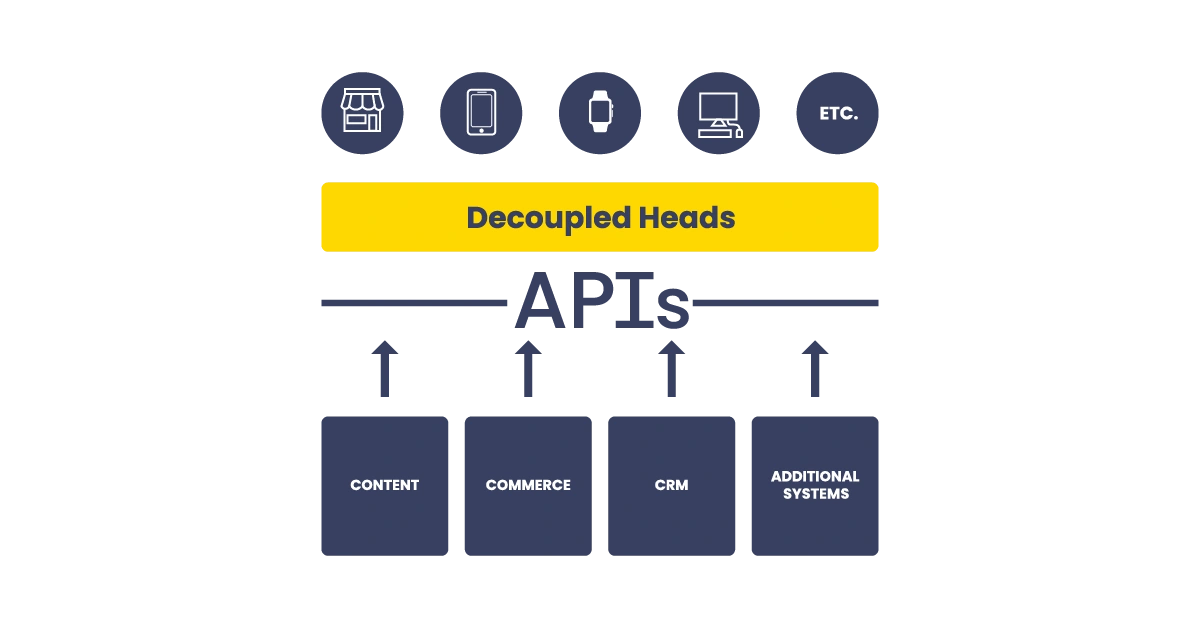
Headless architecture separates the frontend from the backend. The frontend is the presentation layer, and the backend handles content, data, or commerce functionality.
The backend delivers that information through APIs, so teams can build multiple frontends, like web, mobile, or IoT, using the same backend.
Ideal for:
Multichannel experiences
Frontend freedom and faster UI iteration
Marketing teams needing CMS flexibility
Limitations:
Backend still often remains a single unit
Less flexible than fully composable systems
Does not inherently solve scaling or modularity challenges
Composable architecture takes headless a step further by breaking the entire system into modular, independent components. That includes both the backend and the frontend.
Each capability, like search, checkout, authentication, content, or payments, becomes its own service or packaged business capability (PBC). That means you can build, deploy, replace, or scale each part on its own.
Ideal for:
Scaling enterprise platforms
Teams needing independent deployment cycles
Organizations demanding high flexibility and rapid change
Strengths:
Maximum agility
Highly resilient and scalable
Technology-agnostic + vendor-flexible
Composable architecture offers a plethora of tangible advantages to businesses. Here are some:
A composable software foundation enables a company to meet the challenges of the ever-evolving digital scene head-on. Independent, modular components make it possible to:
Add and integrate new features quickly without rewriting existing code.
Swap out or modify a component without disrupting overall system functionality.
Test new features on a smaller scale, minimizing risk and time to market.
Developers are often the biggest fans of composable architectures. The modular approach allows them to:
Leverage pre-built components to put together MVPs much faster.
Avoid reinventing the wheel and focus on adding unique value.
Recompose existing components to adapt to changing consumer demands.
Promote clean and maintainable code practices through modular design and clear component boundaries.
As businesses grow, their software needs evolve. Composable architectures shine in these situations:
They are scalable by design. Individual components can be scaled up or down based on their specific load using techniques like serverless functions.
They are typically API-first, which allows seamless integration with leading technology providers and keeps you at the forefront of innovation.
They are future-proof. You can swap out components for more powerful solutions to accommodate rising demands.
Infrastructures built on the principles of composable design are more reliable and fault-tolerant because:
Isolated components reduce the likelihood of issues propagating throughout the system.
Faults in one component are less likely to impact the overall system, enhancing fault tolerance.
Clear component boundaries make it easier to identify and resolve faults.
Before you start implementing a composable architecture for your enterprise, it’s important to understand its key principles and components. That's what the next few sections cover.
Composable architecture is built from loosely coupled modules. Each module is a self-contained unit with a clear responsibility, and it communicates with other modules through well-defined interfaces, like APIs. Self-contained modules facilitate easier development, testing, and maintenance.
The goal is to minimize dependencies so modules can evolve independently. That means teams can build, test, deploy, restart, modify, or scale one capability without forcing changes across the rest of the system. For example, in an ecommerce platform, keeping inventory management separate from order processing lets each team move faster without stepping on the other’s work.
The ability to reuse pre-built, well-tested components accelerates the product development process and promotes consistency and reliability across applications.
Reusability can deliver tangible benefits across industries. For example, in the e-commerce sector, you can have reusable modules for user authentication, cart management, and product search functionality. Similarly, there can be reusable modules for payment processing, fraud detection, and account management in the fintech industry.
Replaceability and interoperability are core tenets of composable design. Businesses can add new functionalities by introducing additional modules to their ecosystem. Similarly, they can remove older modules no longer needed, promoting scalability as systems can seamlessly be adapted to accommodate changing demands and technological advancements without undergoing major architectural overhauls.
The following sections break down the fundamental technologies composable architectures are built on:
Microservices are often the core building blocks of a composable architecture. Here are some of the characteristics that support composable setups:
Each microservice encapsulates a specific business function and can thus be developed, tested, and deployed as an independent module.
Microservices communicate via well-defined APIs, which promotes loose coupling and minimizes dependencies between components.
Each microservice typically has its own source code repository, which ensures that changes made to one microservice don’t affect others.
By defining clear contracts for communication, APIs ensure interoperability and extensibility in a microservices-based composable architecture. For example, a user authentication microservice may expose an API for user login and authorization, which is available for use by multiple microservices within the architecture.
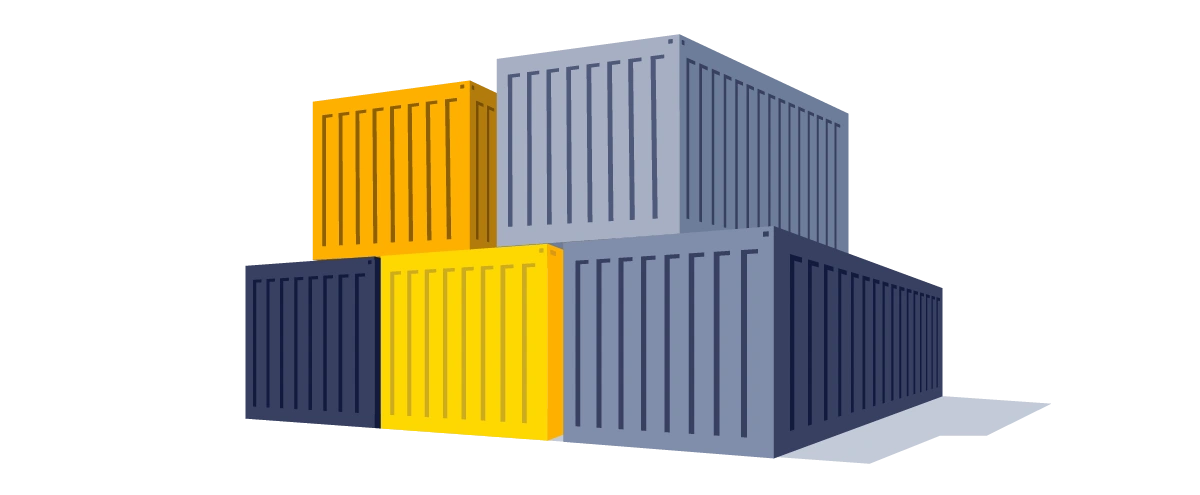
Containerization is an approach that encapsulates everything an application needs to function, including its source code and dependencies, into portable, self-contained units called containers.
Containers ensure that an application receives a consistent runtime environment, regardless of the platform on which it’s executed. They are a top choice for packaging, shipping, and deploying components of a composable architecture because:
Microservices running within containers are isolated from each other, preventing conflicts and increasing fault tolerance.
Containerized components can be easily deployed in different environments without modification.
Containers are much smaller than virtual machines, leading to faster deployment times and efficient resource utilization.
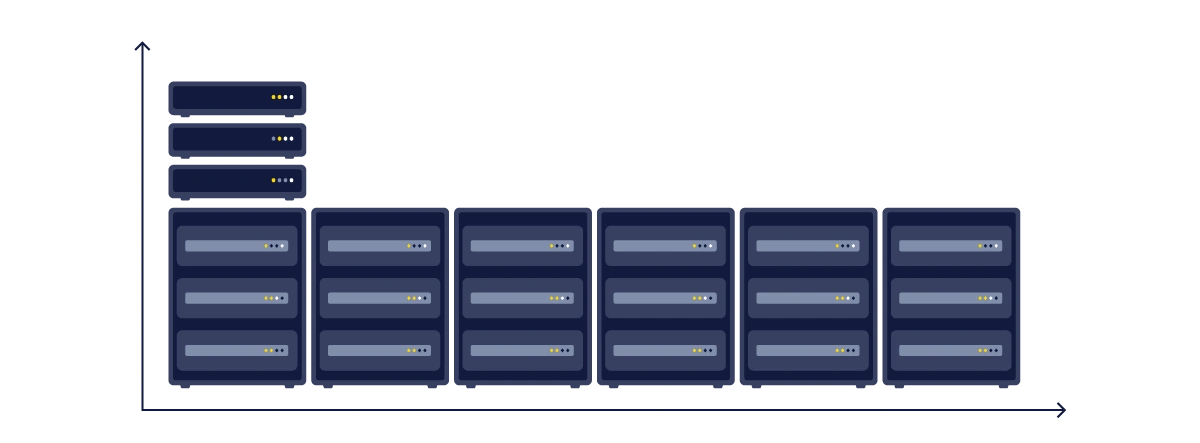
Individual containers can be scaled independently based on their resource needs.
However, managing a myriad of independent microservice containers can be challenging. This is why composable enterprises use orchestration tools like Kubernetes to automate the deployment, scaling, and management of containerized applications. Kubernetes, an open-source platform, ensures containers are always running at the desired scale and meeting resource requirements.
To get your composable architecture right, it’s important to adhere to certain design patterns and best practices regarding dependency management.
A design pattern is a set of guidelines that helps solve common software design problems. Here are a few design patterns commonly used for composable architectures:
Facade pattern: Simplifies interactions with complex systems by providing a single interface to a collection of underlying components
Repository pattern: Encapsulates data access logic, promoting code reuse and easier integration with different data storage solutions
Factory pattern: Enables the creation of objects without specifying their concrete classes, promoting flexibility and decoupling
Observer pattern: Facilitates event-driven communication between components by defining a one-to-many dependency between objects
By following these established patterns, developers can design modular systems that are easier to maintain, reuse, extend, and adapt. For example, Netflix uses the Observer and Observable patterns for its highly scalable APIs. Similarly, AWS uses the builder pattern in its SDKs to make it easier to work with immutable objects.
These best practices can help you make modularity and reusability fundamental aspects of your composable architecture.
Follow the single responsibility principle, which dictates that each component should have a clear and well-defined responsibility.
Aim to keep components highly cohesive, meaning each module should contain closely related functionality. At the same time, minimize dependencies between modules to reduce the risk of cascading changes.
Anticipate future changes and requirements by designing components that are extensible by design. For example, design components with extension points or hooks for easy customization.
Document the architecture, design patterns, and interfaces used in your composable system to ensure clarity among all relevant stakeholders.
Prioritize straightforward solutions over complex ones to ensure that components are easier to understand, maintain, and reuse.
Some level of dependency between loosely coupled components is inevitable. Here are some techniques to minimize dependencies, manage them effectively, and promote loose coupling:
Avoid unnecessary dependencies between components, as they can lead to tight coupling. Tightly coupled systems are difficult to change and maintain. As a golden rule, before creating a dependency, carefully consider whether it’s essential for the functionality of the component.
Use dependency inversion principles to manage dependencies. Instead of relying on concrete implementations, depend on abstractions or interfaces. This allows modules to be replaced without affecting other parts of the system.
Prefer event-based communication over synchronous interactions between components. Event-based communication allows components to communicate asynchronously, reducing direct dependencies and promoting loose coupling.
For example, consider an event-driven, composable ecommerce system. The shopping cart module publishes an "Item Added" event with product details. The product information component, subscribed to this event, then updates its inventory data without needing to know directly about it or depend on the shopping cart module.
Use versioning tools to manage dependencies between components to prevent unexpected issues when components are updated.
Testing and debugging composable systems requires a comprehensive approach that accounts for the modular nature of the architecture.
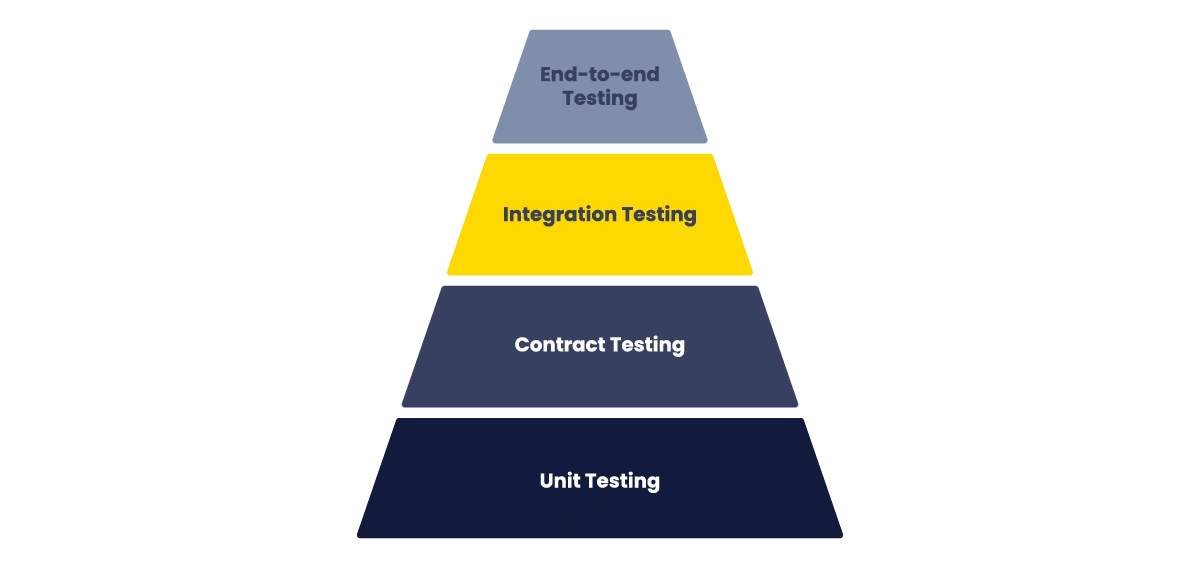
Here are some approaches that your developers and QA engineers can use to test the functionality and resilience of your composable architecture:
Unit testing is the foundation of any testing strategy. It focuses on validating individual components in isolation, ensuring each component functions as expected before integration.
Integration testing verifies how components interact with each other. It is crucial for identifying compatibility issues and ensuring a smooth flow of data.
Contract testing validates that components adhere to their API contracts. It guarantees consistent behavior and prevents unexpected integration failures.
End-to-end tests check whether all components are working together as expected to achieve the desired outcomes.
Rigorous testing of composable architectures is crucial to ensure early fault detection, functional stability, and reliability. Here are a few best practices to follow:
Automate testing to streamline the testing process, ensure consistent coverage, and catch bugs early.
Integrate testing into your CI/CD pipelines to ensure that bugs and unintended changes never make it to production.
Use mocks and stubs to simulate dependencies during unit testing. This enables efficient testing of individual components in isolation.
Parameterize tests to cover a wide range of input scenarios and edge cases. This will help identify potential vulnerabilities and edge case failures that may arise in larger composable architectures.
Debugging in a composable setup can pose unique challenges due to the distributed and modular nature of the system. Here are a few common pitfalls:
It can be difficult to trace the data flow and control across multiple interconnected modules.
Identifying and isolating issues caused by dependencies can be challenging.
Debugging asynchronous communication and event-driven workflows can be challenging, especially if you don’t have centralized logging.
Finding the root cause of a system-wide bottleneck or outage can be problematic, particularly if you don’t have a robust monitoring system.
To avoid and overcome the aforementioned challenges, leverage these strategies:
Correlate logs and trace requests across distributed components using structured logging formats and distributed tracing tools (like Zipkin). Moreover, consider implementing centralized logging through tools like Logstash.
Expose diagnostic endpoints or health checks in each module to provide visibility into its internal state and health.
Use techniques like fault injection and chaos engineering to identify weaknesses and vulnerabilities in the system proactively.
Use remote debugging tools to troubleshoot distributed components running in different environments or containers.
Composable architectures have helped several organizations address real-world challenges. Let's look at a couple of examples.
With over half a billion active users globally, Spotify uses a composable architecture to ensure a seamless music streaming experience. This approach combines APIs, components, and resources to scale and adapt the platform to meet its users' diverse needs.
Freddie's Flowers is a fresh flowers subscription service from England. As they planned to expand out of the UK, they realized a need to ditch their legacy stack for a more scalable option. Opting for the composable approach, they leveraged ButterCMS, a headless CMS, to build a composable content stack. By decoupling the presentation layer from the backend, they empowered their marketers to create dynamic landing pages at scale without developer assistance.
Before diving into composable architecture, take the following considerations into account:
Establish clear evaluation criteria to determine the suitability of a composable architecture. Consider factors like system complexity, agility expectations, and the need for independent scaling. For example, composable may not be a good fit if your project is a simple, well-defined application with limited future growth projections.
Anticipate and prepare for potential challenges you may face during and after implementation. These can include security issues, dependency management problems, and stakeholders' resistance to change.
Composable architecture requires a skill set different from that of monolithic development. Assess your team's capabilities and consider training or hiring developers with relevant experience.
Understand the impact of composable on existing systems. Consider aspects like integration with legacy systems, data migration requirements, and potential workflow disruptions.
Develop a well-defined migration strategy for a smooth transition. Incremental adoption, phased implementation, and prioritization of high-impact areas can help mitigate risks.
Composable architecture offers organizations a flexible approach to building and adapting software applications. However, to harness its maximum potential regarding scalability and efficiency, it is vital to learn its principles, components, testing strategies, and best practices.
Ready to see composability in action? Start a free ButterCMS trial and build with modular content from day one.
Composable architectures are built using loosely coupled microservices, which are inherently easier to maintain, adapt, and scale than monoliths.
Microservices are a core building block of composable architectures. Each microservice handles a specific business function in a composable setup.
PBCs are modularized business functionalities that can be independently developed, deployed, and integrated in a composable architecture.
A headless architecture separates the frontend of a website/app from its backend. A composable architecture further breaks down the frontend and backend layers into smaller modules.
In a composable ecommerce application, core functionalities are distributed across self-contained modules, such as product catalog management, authentication, order fulfillment, and layout. This modular nature enhances the ecommerce app's customizability, agility, and scalability.